Blogs
Deep Soil Mixing: Method, Process, Benefits, Equipment and Applications
Blogs • GRIMTECH Engineering Team
Blogs • GRIMTECH Engineering Team
Construction on weak, soft, or highly compressible soil can lead to excessive settlement, foundation instability, groundwater problems, and project delays. Deep Soil Mixing is an advanced ground improvement method used to enhance the engineering properties of such soil without completely excavating and replacing it.
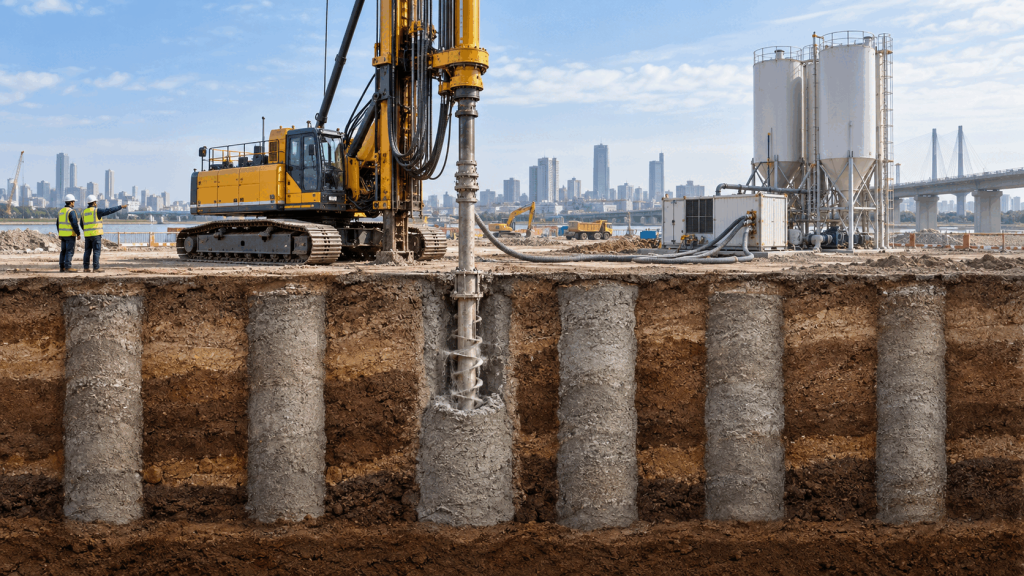
The Deep Soil Mixing method mechanically blends existing soil with cementitious binders to create stronger and more stable soil columns, panels, or blocks below ground. It is widely used for foundation support, embankment stabilization, excavation support, groundwater control, and settlement reduction.
This guide explains the Deep Soil Mixing technique, its construction procedure, equipment, applications, advantages, and the differences between Wet and Dry Deep Soil Mixing.
Deep Soil Mixing, also called DSM or the Deep Mixing Method, is an in-situ soil improvement process. “In situ” means that the soil is treated at its existing location instead of being removed from the site.
During the Deep Soil Mixing process, a specialised machine penetrates weak ground and blends it with binders such as cement, lime, or an engineered binder mixture. The binder reacts with the soil and water to form hardened soil-binder material with improved engineering properties.
Depending on the project requirements, the improved soil can be constructed as:
The resulting soil-binder elements can have greater strength, higher stiffness, lower compressibility, and reduced permeability compared with untreated soil.
The Deep Soil Mixing method uses mechanical mixing tools to break down the natural soil structure and distribute a controlled amount of binder throughout the treatment area.
A Deep Soil Mixing machine normally has one or more rotating shafts equipped with cutting blades, paddles, or augers. These mixing tools penetrate the ground to the required depth while binder is delivered through the equipment.
The binder may be introduced as a liquid slurry or dry powder. The selection depends on soil type, natural moisture content, groundwater conditions, required strength, environmental restrictions, and project specifications.
As the soil and binder are thoroughly mixed, they create a uniform soil-cement material. Once the material cures, it forms a stronger underground element capable of improving ground performance.
The final result depends on several factors, including:
Because these factors vary between sites, every Deep Soil Mixing project requires a site-specific design.
A properly planned Deep Soil Mixing procedure includes investigation, testing, construction, monitoring, and verification.
The first step is to understand the ground conditions. Engineers conduct soil investigations to identify weak layers, soil composition, groundwater levels, obstructions, and the depth of treatment required.
The investigation may include boreholes, soil sampling, laboratory testing, Standard Penetration Tests, and Cone Penetration Tests. The collected information helps determine whether Deep Soil Mixing technology is suitable for the project.
The contractor develops a suitable binder mix based on the soil characteristics and required performance. Common materials include cement, lime, and blended cementitious binders.
Laboratory trials may be conducted using different binder quantities. The treated samples are tested to evaluate strength, stiffness, workability, and permeability.
The objective is to select a mixture that meets the engineering requirements without using an unnecessary quantity of binder.
Before full-scale production begins, trial columns may be installed at the site. These trials confirm whether the proposed Deep Soil Mixing technique, machinery, binder dosage, and installation parameters can achieve the required results.
Samples from the trial columns may be tested before approving the final construction methodology.
The Deep Soil Mixing equipment is positioned at the designed column location. Correct alignment and verticality are important, particularly when overlapping columns are required to form a continuous wall or barrier.
The rotating mixing tool penetrates the soil to the specified depth. Binder is introduced during penetration, withdrawal, or both, depending on the selected system.
Machine parameters such as depth, rotation speed, binder flow, injection pressure, penetration rate, and withdrawal rate are monitored throughout the operation.
The cutting blades or augers mechanically mix the binder with the existing soil. Adequate mixing energy is required to produce consistent treated material and minimise untreated pockets.
When the tool reaches the required depth, additional mixing may be carried out before it is withdrawn.
The completed process leaves a soil-mixed column in the ground. Multiple columns can be arranged or overlapped to create walls, panels, grids, or stabilised blocks.
The treated material gradually gains strength as the binder reacts with the soil and water. Curing time depends on binder type, soil chemistry, moisture, temperature, and project specifications.
Quality control verifies that the completed work meets the approved design. It may include:
Accurate digital records provide traceability for every installed column.
Wet Deep Soil Mixing uses a binder mixed with water to form a pumpable slurry. The slurry is delivered through the mixing shaft and blended with the soil using rotating tools.
This method can be used for many types of treatable soil and is commonly selected where accurate slurry delivery and thorough binder distribution are required.
Typical applications include:
During Wet Deep Soil Mixing, the contractor must control the slurry density, water-to-binder ratio, injection rate, pressure, and total binder quantity. These factors influence the consistency and final strength of the treated soil.
Dry Deep Soil Mixing introduces powdered binder directly into the ground using compressed air. The binder reacts with moisture already present in the soil.
The method is generally suitable for soft, wet, and moisture-rich soils. Because additional water is not used to prepare a slurry, Dry Deep Soil Mixing may produce less wet spoil in suitable ground conditions.
However, its effectiveness depends on natural soil moisture, binder distribution, air pressure, soil chemistry, and mixing quality. Dust management and environmental controls may also be necessary.
| Feature | Wet Deep Soil Mixing | Dry Deep Soil Mixing |
|---|---|---|
| Binder form | Liquid slurry | Dry powder |
| Water requirement | Water is added | Uses natural soil moisture |
| Delivery system | Pump and injection lines | Compressed-air system |
| Typical suitability | Broad range of treatable soils | Soft, high-moisture soils |
| Important controls | Slurry ratio, pressure and flow | Moisture, air pressure and dosage |
| Spoil condition | May generate wet spoil | May reduce wet spoil |
The best method should be selected after examining the site conditions and required engineering performance. Neither option is automatically suitable for every project.
Deep-mixed columns can improve weak ground below buildings, industrial plants, tanks, bridges, and other structures. The strengthened soil helps distribute structural loads and improve foundation performance.
Soft soil can compress when subjected to new loads. Deep Soil Mixing increases the stiffness of the treated ground and helps control total and differential settlement.
The technique can support highway, railway, approach, and flood-protection embankments constructed over weak soil.
Overlapping columns can form soil-mixed retaining walls around deep excavations. Structural reinforcement may be inserted where required by the engineering design.
Continuous soil-mixed panels can create low-permeability barriers that help reduce groundwater movement and seepage into excavations.
Deep-mixed elements can improve the shear strength of weak soil and provide additional resistance along potential slope failure zones.
Deep Soil Mixing technology may be used to increase ground stiffness and reduce deformation in liquefaction-sensitive areas. The treatment pattern must be designed according to site-specific seismic conditions.
Important Deep Soil Mixing benefits include:
One of the most valuable advantages of Deep Soil Mixing is its ability to improve existing ground in place. This can reduce excavation, material transportation, disposal requirements, and disruption around the project site.
The benefits achieved depend on design quality, ground conditions, construction control, and testing.
Specialised Deep Soil Mixing equipment is necessary to achieve the required depth, diameter, mixing quality, and production rate.
A typical setup may include:
The Deep Soil Mixing machine should be selected according to soil resistance, treatment depth, column size, available working space, headroom, and project-access conditions.
Deep Soil Mixing is a specialist operation that requires geotechnical understanding, appropriate machinery, trained operators, and strict quality control.
When selecting a Deep Soil Mixing contractor, consider:
A professional Deep Soil Mixing company should review the site investigation, structural loads, groundwater conditions, treatment depth, and performance criteria before recommending a solution.
Deep Soil Mixing is an effective ground improvement technique for strengthening weak soil, reducing settlement, supporting foundations, stabilising embankments, retaining excavations, and controlling groundwater movement.
Both Wet Deep Soil Mixing and Dry Deep Soil Mixing can produce strong soil-binder elements, but the appropriate method depends on the project’s ground conditions and engineering requirements.
Successful implementation requires proper investigation, binder testing, suitable Deep Soil Mixing equipment, controlled construction, and reliable quality verification.
For professional Deep Soil Mixing services, contact Grimtech. Our team can assess your project requirements and recommend an appropriate ground improvement solution for safe and efficient construction.
Subscribe in the footer for project highlights and technical insights from our engineers.