Blogs
Stone Column Ground Improvement: Complete Guide, Process & Real-World Benefits
Blogs • GRIMTECH Engineering Team
Blogs • GRIMTECH Engineering Team
[vc_row][vc_column][vc_column_text]
Stone Columns are one of the most trusted ground improvement solutions used worldwide to enhance weak soil and support heavy structures. Whether you’re working on highways, industrial buildings, embankments, or commercial foundations, stone columns provide a fast, reliable, and cost-effective way to strengthen the ground.
In this blog, we’ll explain everything—how stone columns work, the installation process, applications, and why this technique is widely preferred in geotechnical engineering.
A stone column, also known as a vibro stone column, is a vertical column constructed by inserting compacted aggregates into weak soil. These columns reinforce the ground, reduce settlement, and improve load-bearing capacity.
The method is especially effective in soft clays, loose silts, and granular soils.
Stone columns work on three main principles:
The process increases the strength of loose or soft soil.
Stone columns act like strong vertical pillars transferring load to deeper soil layers.
Aggregates enhance soil permeability, reducing pore pressure and allowing faster consolidation.
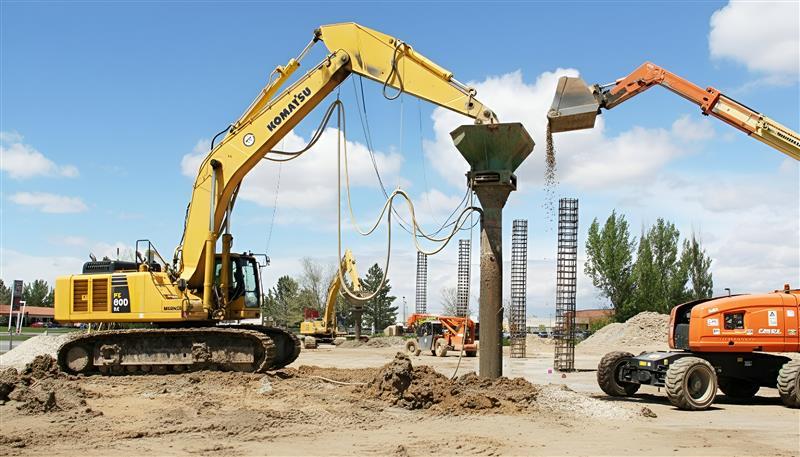
There are two main methods used for Stone Column construction — Vibro Replacement (Wet/ Dry) and Top-Feed Bottom-Feed Method. Here is the general installation process:
Engineers conduct soil tests, bore logs, SPT, CPT, and laboratory analysis to understand soil behavior, density, depth, and groundwater conditions.
A powerful vibro probe is lowered into the soil using its own vibration and jetting action (for wet method) or compressed air (dry method). This creates a cylindrical cavity.
Crushed stones or gravel are added into the cavity either from the top or bottom, depending on the equipment.
The vibro probe compacts stones in layers, forming a dense column. The process continues until the designed diameter and depth are achieved.
After installation, engineers conduct CPT testing, load tests, and settlement monitoring to ensure the stone columns meet performance requirements.
Stone Columns are ideal for enhancing soils under:
Provides stability and reduces settlement under heavy traffic and dynamic loads.
Perfect for warehouses, factories, storage tanks, and logistics hubs.
Improves foundation performance in soft, compressible soils.
Stone columns mitigate liquefaction in earthquake-prone zones by improving drainage and soil stiffness.
Used for container yards, breakwaters, and coastal structures.
Ensures uniform settlement and long-term stability of road infrastructure.
Uses compressed air and a vibro probe to form the column — ideal in cohesionless soils.
Uses water jetting to penetrate the soil — ideal for dense, cohesive soils.
Stones are dropped from the top of the borehole.
Aggregates are fed through the vibro probe — best for underwater or high groundwater conditions.
Cheaper than deep foundation methods like piling.
Rapid installation helps maintain project timelines.
Helps reduce pore pressure and improve soil stability.
Uses natural aggregates—no chemicals involved.
Performs well in clay, silt, and loose sand.
| Method | Suitable Soil | Cost | Effectiveness |
|---|---|---|---|
| Stone Columns | Soft–medium soils | Economical | High |
| Piling | Very poor soils | Costly | Very High |
| Sand Compaction Piles | Granular soils | Moderate | Medium |
| Jet Grouting | Complex soils | Expensive | Very High |
Stone Columns stand out as a balance between cost, performance, and installation speed.
High load-bearing capacity
Minimal vibration and environmental impact
Quick installation
Better long-term settlement control
Suitable for various project types
Stone columns are a powerful and proven ground improvement technique that deliver strength, stability, and long-term reliability to weak soils. Thanks to their speed, cost-effectiveness, and environmental friendliness, they remain a preferred choice for modern infrastructure, industrial construction, and heavy load foundations.
If your project requires safe and stable ground improvement, stone columns offer one of the most dependable solutions.
[/vc_column_text][/vc_column][/vc_row]
Subscribe in the footer for project highlights and technical insights from our engineers.