PHC vs. RC Spun Piles: Choosing the Right Precast Pile for Your Project
Blogs
Blogs
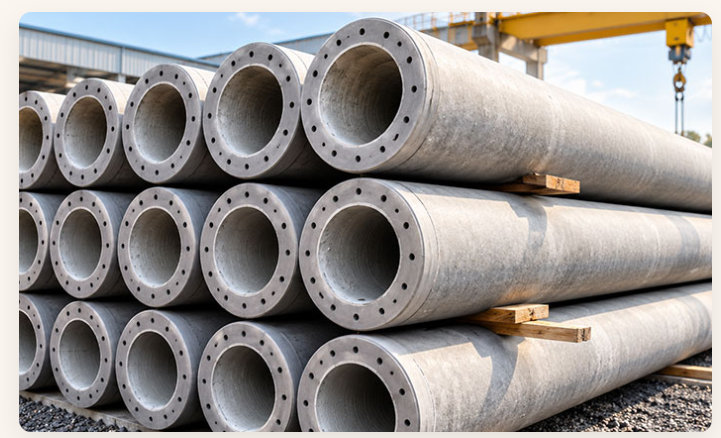
Quick Engineering Summary: Both PHC (Prestressed High-Strength Concrete) and RC (Reinforced Concrete) spun piles are hollow cylindrical precast piles manufactured via high-speed centrifugal compaction. PHC piles use pre-tensioned high-tensile steel strands and autoclave-cured concrete (typically M60–M80+), offering higher axial load capacity, superior cracking resistance during lifting and driving, and better durability in saline marine soils. RC piles use conventional deformed rebar cages and lower-grade concrete (typically M35–M50), making them more economical for light-to-moderate axial loads and shallow driving depths.
When planning deep foundations for industrial plants, highway approaches, solar farms, or coastal marine structures, structural engineers frequently evaluate factory-manufactured precast spun piles over cast-in-situ bored piles. Factory casting eliminates borehole necking, slurry contamination, and 28-day on-site concrete curing delays.
However, selecting between PHC spun piles and RC spun piles directly impacts foundation safety, driving survival rates, and overall project budgets. Understanding how each pile performs under bending moments, tensile driving stresses, and aggressive soil conditions ensures your foundation design matches actual site loads.
Unlike solid square precast piles cast in static horizontal beds, spun piles are hollow cylindrical members fabricated by spinning wet concrete inside tubular steel molds at high rotational speeds (typically 800–1,000 RPM). Centrifugal force compacts dense aggregates against the outer mold wall while expelling excess water and air through the hollow core.
This centrifugal compaction produces a dense, low-permeability concrete shell. Once cast, the piles are categorized into two primary structural types based on their reinforcement and curing process:
Prestressed High-Strength Concrete (PHC) Spun Piles: Reinforced with pre-tensioned high-tensile PC steel wires or strands, combined with spiral confinement wire, and cured via high-pressure steam autoclaving.
Reinforced Concrete (RC) Spun Piles: Reinforced with standard non-prestressed deformed steel bars (Fe 500/550D) and spiral ties, typically cured using standard atmospheric steam or water curing.
Deep foundation piles rarely carry purely vertical loads. Wind, seismic forces, crane braking, and lateral earth pressures in soft clays subject piles to substantial bending moments.
PHC Spun Piles: Pre-tensioning applies a uniform compressive stress across the concrete wall before any external load reaches the pile. Before the concrete can experience tension under lateral bending, the applied moment must first overcome this built-in pre-compression. As a result, PHC piles maintain a much higher cracking bending moment and stiffer cross-section under working loads.
RC Spun Piles: Because RC piles carry zero initial pre-compression, the concrete on the tension face reaches its flexural tensile limit earlier. Once that threshold is crossed, hairline cracks open and the internal steel rebar carries the tensile force. While RC piles still have strong ultimate failure capacity if heavily reinforced, they deflect more under working lateral loads.
Many precast pile failures happen before the pile ever carries building loads—during crane hoisting, yard stacking, or impact hammer driving.
Lifting & Transport: Long slender piles (12 m to 15 m segments) act as beams under their own self-weight when lifted. PHC piles resist flexural cracking during two-point or single-point pitching, whereas long RC piles require strict lifting-point controls to avoid mid-span tension cracks.
Driving Tensile Waves: When a hydraulic impact hammer drives a pile through soft clay above a dense sand layer, a compressive shockwave travels down the pile and reflects back upward as a tensile wave. Because concrete is naturally weak in tension, non-prestressed RC piles can develop horizontal tension cracks under heavy hammer blows. Pre-compression inside PHC piles neutralizes these reflected tensile stresses, allowing contractors delivering spun piles construction services to drive piles harder and deeper without structural damage.
In coastal regions, saline marine mudflats, and sulfate-rich industrial soils, moisture and chloride ions can penetrate microscopic pores and corrode internal steel.
PHC piles undergo high-pressure autoclave steam curing alongside centrifugal compaction, creating an ultra-dense matrix with minimal capillary voids. Because the concrete remains crack-free under normal service loads, corrosive groundwater cannot easily reach the prestressing strands. RC piles, if cracked during driving or bending, allow faster chloride ingress toward the conventional rebar.
Unit Rate Comparison: On a pure per-meter material basis, RC spun piles are roughly 15% to 25% cheaper than PHC piles of the same diameter because they avoid prestressing jacks, high-tensile PC strands, and autoclave curing chambers.
Total Project Cost: For heavy loads, PHC piles often deliver a lower total foundation cost. Because a single 500 mm or 600 mm PHC pile carries significantly higher axial load than an equivalent RC pile, structural designers can reduce the total number of piles required, shrink pile cap sizes, and cut driving rig days on-site.
The project involves heavy axial or lateral loads (power plants, refinery pipe racks, highway viaducts, multi-story towers).
Soil conditions include saline marine mudflats, coastal zones, or high water tables requiring long-term corrosion immunity.
Piles must be driven through hard intermediate strata or dense sand layers using hydraulic impact hammers.
Project schedules demand rapid installation with zero risk of handling or driving cracks.
Structural loads are light to moderate (solar mounting structures, boundary walls, light industrial PEB sheds, low-rise warehouses).
Soil strata are relatively uniform and soft, allowing low-stress hydraulic static jacking or light driving without hard-strata rebound waves.
Upfront material cost per linear meter is the primary budget constraint and pile lengths are short (under 10–12 meters).
Regardless of whether you specify PHC or RC piles, field execution must follow IS 2911 (Part 1 / Section 3) for driven precast concrete piles. Experienced contractors verify pile performance using:
Full-Penetration Splicing: When project depths exceed 12–15 meters, segments are joined on-site using machined steel end plates welded circumferentially and sealed with anti-corrosive epoxy coatings.
Low-Strain Pile Integrity Testing (PIT): Confirms shaft continuity and splice weld quality after driving.
High-Strain Dynamic Load Testing (HSDT) & Static Tests: Verifies ultimate bearing capacity and refusal criteria per IS 2911 (Part 4) and ASTM D4945 through specialized pile testing solutions.
Choosing between PHC and RC spun piles starts with reviewing your borehole logs, design bending moments, and site access constraints. Whether your project requires zero-vibration hydraulic static jacking near urban structures or heavy impact driving in coastal mudflats, working with an experienced geotechnical team for spun piles construction services ensures proper pile selection, splice integrity, and verified load performance.
PHC spun piles use pre-tensioned high-tensile steel strands and M60–M80+ autoclave-cured concrete for high load capacity and crack resistance. RC spun piles use conventional non-prestressed rebar and M35–M50 concrete for lighter structural loads.
PHC spun piles are preferred for marine jetties and saline mudflats because their autoclave-cured, pre-compressed concrete shell resists micro-cracking and blocks chloride penetration.
Yes, RC spun piles cost less per linear meter to manufacture. However, for heavy industrial structures, PHC piles can lower total foundation costs by reducing the total number of piles and pile cap concrete volume needed.
Precast driven concrete piles are designed and installed according to IS 2911 (Part 1 / Section 3), while static and dynamic load testing follows IS 2911 (Part 4).
Subscribe in the footer for project highlights and technical insights from our engineers.