Blogs
Ground Improvement: Techniques, Methods & Modern Solutions in Construction
Blogs • GRIMTECH Engineering Team
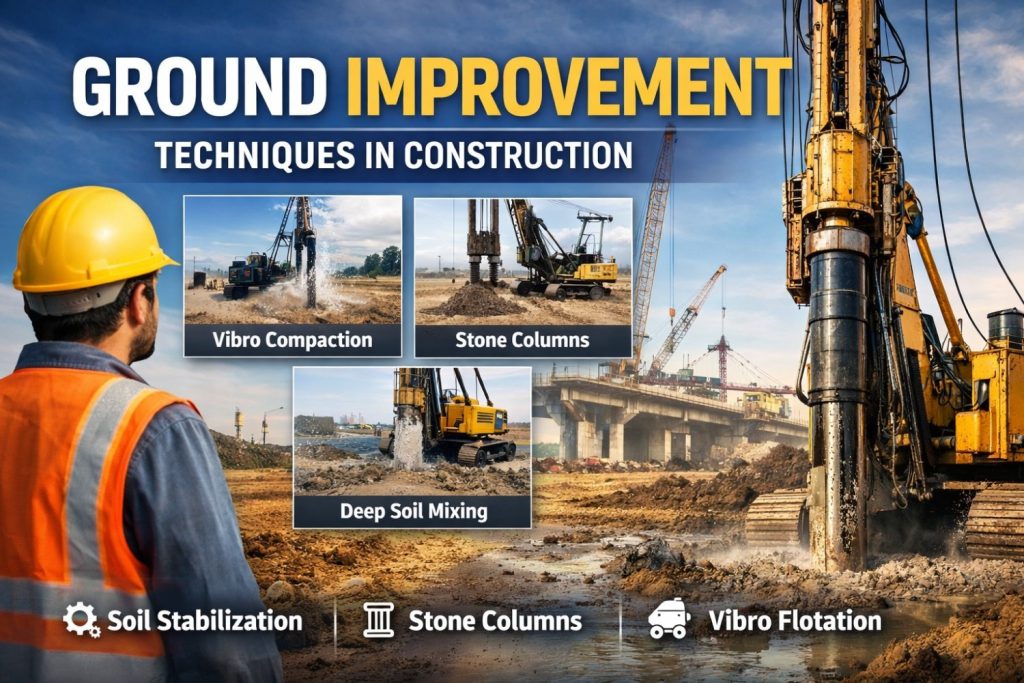
Blogs • GRIMTECH Engineering Team
Ground improvement is a essential technique in modern creation that guarantees soil is robust sufficient to support systems competently and correctly. Whether it’s highways, bridges, excessive-rise homes, or commercial initiatives, ground development strategies play a key position in enhancing soil homes and stopping structural failures.
In this comprehensive guide, we’ll explore soil improvement techniques, including Deep Soil Mixing, vibro compaction, stone columns, and other advanced ground stabilization methods used in modern construction.
Ground development refers to a number of strategies used to enhance the engineering residences of soil. These techniques increase soil power, lessen agreement, and enhance load-bearing ability, making the floor appropriate for production.
It is extensively utilized in:
Using proper floor improvement in construction offers several advantages:
✔ Improves soil energy and balance
✔ Reduces agreement and deformation
✔ Enhances load-bearing ability
✔ Minimizes construction risks
✔ Increases lifespan of systems
This is why civil engineering floor improvement has become vital in cutting-edge infrastructure improvement.
There are several soil stabilization strategies used depending on soil situations and project requirements:
The vibro compaction method is used to densify loose granular soils like sand. A vibrating probe is inserted into the floor, rearranging soil particles into a denser configuration.
Key Benefits:
The vibro flotation method (also called vibroflotation) is a famous ground stabilization method used for deep soil improvement.
Applications:
Stone column installation involves putting columns of crushed stone into smooth soil to enhance strength and drainage.
Advantages:
Various soil stabilization strategies are used to regulate soil homes:
These methods are broadly utilized in infrastructure soil stabilization tasks inclusive of roads, railways, and airports.
Deep Soil Mixing (DSM) is an advanced ground improvement technique used to improve the strength and stability of weak or soft soils. In this method, in-situ soil is mechanically mixed with binding agents such as cement or lime to form stronger soil-cement columns or panels.
The deep soil mixing method is particularly useful where conventional foundation solutions may not be suitable. It can improve soil bearing capacity, reduce settlement, and increase overall ground stability.
Applications of Deep Soil Mixing:
For projects requiring advanced ground improvement solutions, Deep Soil Mixing can be selected based on soil conditions, required strength, groundwater conditions, and project requirements.
Heavy weights are dropped from heights to compact unfastened soil layers, making it suitable for construction.
Ground improvement is vital in various sectors:
These programs highlight the importance of infrastructure soil stabilization in large-scale developments.
Selecting the fine floor stabilization technique depends on:
A right geotechnical investigation is continually recommended before choosing a technique.
With fast urbanization and infrastructure boom, call for for floor development strategies is increasing in India. Advanced technologies like vibro techniques, geosynthetics, and green stabilization answers are shaping the destiny of the industry.
Ground development is a essential part of modern creation that ensures safety, durability, and efficiency. From vibro compaction approach to stone column set up, these superior soil development strategies assist engineers triumph over difficult ground conditions.
Subscribe in the footer for project highlights and technical insights from our engineers.