
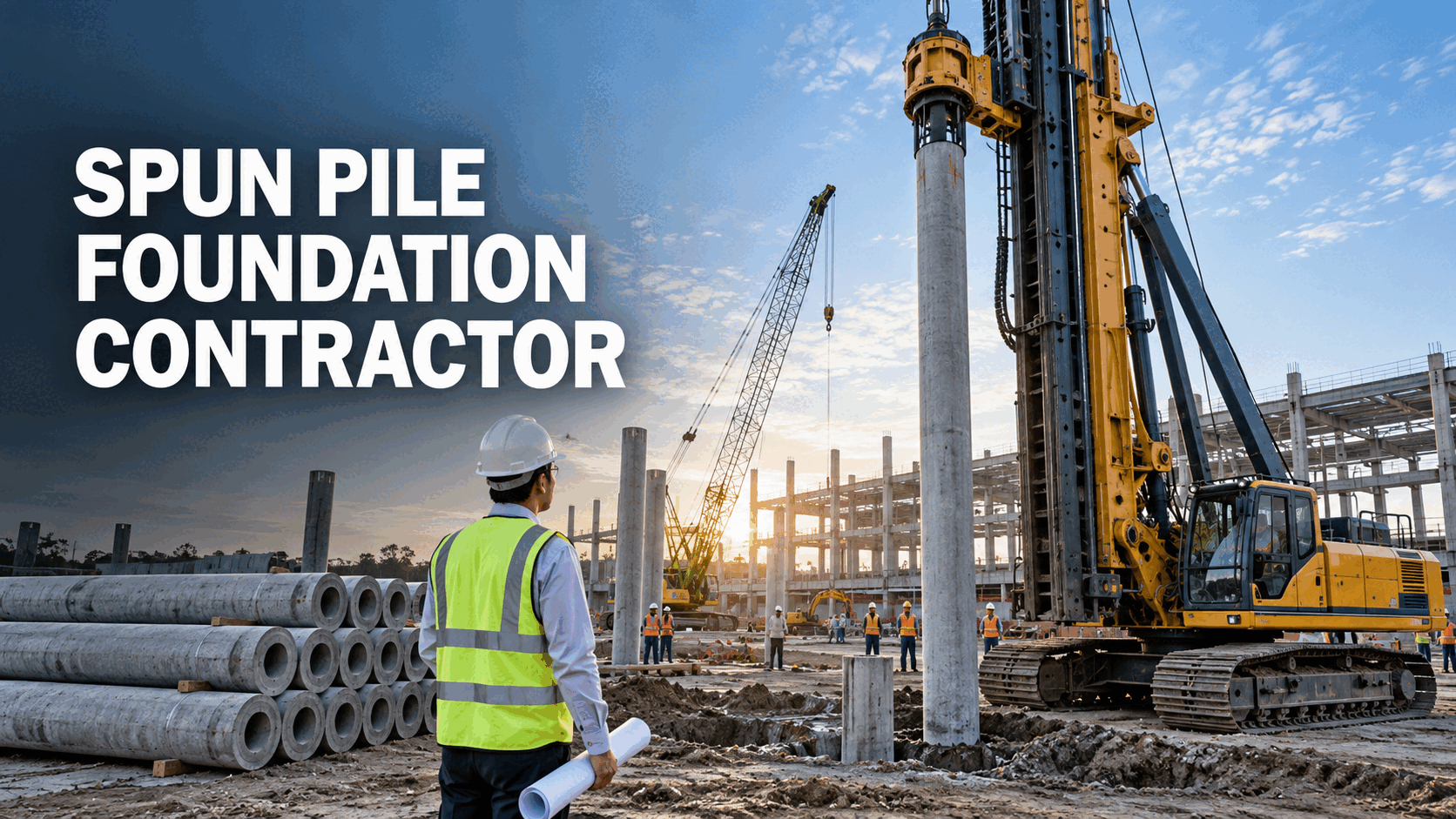
Spun Pile Foundation Contractor: The Complete Engineering Guide to PHC Pile Installation & Driving Services
Modern infrastructure assets—ranging from mega thermal power stations, chemical processing plants, and refinery tank farms to highway viaducts, coastal jetties, and multi-story commercial towers—depend on deep foundation systems capable of transferring immense structural loads through weak, compressible upper soil layers into deeper bearing strata.
In high water-table environments, soft marine clays, and sulfate-laden coastal soils, conventional cast-in-situ bored piling often encounters serious site vulnerabilities. These include borehole necking, mud contamination, cold joints during underwater tremie pours, and mandatory 28-day concrete curing periods that halt project momentum.
To overcome these structural risks and schedule bottlenecks, structural consultants, developers, and EPC leaders increasingly specify factory-engineered spun pile foundation solutions. Manufactured under controlled conditions, prestressed concrete spun piles arrive on-site fully cured, dimensionally verified, and ready for immediate driving and testing.
Below is an in-depth engineering guide covering the manufacturing mechanics, technical specifications, execution methodologies, and criteria for selecting a certified spun pile foundation contractor for complex infrastructure projects.
What is a Spun Pile (PHC Pile)?
A spun pile—formally designated as a Prestressed High-Strength Concrete (PHC) pile—is a hollow, tubular precast concrete foundation member reinforced with longitudinal high-tensile prestressing steel wires (PC strands) and spiral confinement rebar.
Unlike traditional static precast concrete piles cast in wooden or flat steel beds, spun piles derive their strength and structural density from centrifugal casting technology:
1. High-Tensile Steel Cage Assembly and Pre-Tensioning
High-strength steel strands (ultimate tensile strength exceeding 1420–1570 MPa) are arranged symmetrically inside a cylindrical steel mold. Longitudinal reinforcement is pre-tensioned using automated hydraulic jacks to induce a calculated pre-compression across the cross-section, which neutralizes tensile stresses caused by handling, driving, and bending loads.
2. High-Grade Concrete Batching
Specialized low-water-cement ratio concrete (typically Grade M60 to M80+) modified with superplasticizers and silica fume is placed into the cylindrical mold.
3. Centrifugal Spinning
The closed cylindrical mold is placed on high-speed spinning rollers. The mold accelerates through low, intermediate, and high-speed phases (reaching rotational speeds of 800 to 1,000 RPM). The resultant centrifugal force—tens of times greater than gravity—compresses the dense aggregate and cement paste against the outer perimeter of the mold. Simultaneously, excess water and trapped air bubbles are driven inward into the central void and subsequently drained, yielding an exceptionally dense, low-permeability concrete shell.
4. Steam Curing and Autoclave Processing
The spun pile undergoes initial atmospheric steam curing at 65°C to 80°C, followed by secondary curing in a pressurized steam autoclave at approximately 10 atmospheres (180°C). This accelerated thermal-hydro process promotes rapid crystalline silicate hydrate formation, allowing the concrete to achieve its full design compressive strength (up to 80–90 MPa) within 24 hours.
Technical Specifications and Dimension Matrix
Spun piles are categorized by outer diameter, shell wall thickness, and prestressing strength grade (Class A, B, or C per structural bending moment requirements):
| Nominal Outer Diameter (mm) | Wall Thickness (mm) | Standard Concrete Strength (MPa) | Effective Prestress (MPa) | Nominal Axial Capacity (kN) | Typical Application |
| 300 mm | 60 mm | 60 – 80 MPa | 4.0 – 6.0 MPa | 600 – 950 kN | Solar park tracking frames, light industrial PEB structures |
| 400 mm | 75 mm | 60 – 80 MPa | 4.0 – 8.0 MPa | 1,100 – 1,750 kN | Multi-level residential basements, logistics warehouses |
| 500 mm | 90 mm | 80 MPa | 5.0 – 10.0 MPa | 1,900 – 2,800 kN | Heavy industrial floors, bridge approach flyovers |
| 600 mm | 100 mm | 80 MPa | 5.0 – 10.0 MPa | 2,800 – 4,000 kN | Thermal power plants, metro viaduct foundations |
| 800 mm – 1000 mm | 120 – 140 mm | 80+ MPa | 6.0 – 12.0 MPa | 4,800 – 8,000+ kN |
Spun Piles vs. Cast-in-Situ Bored Piles: Detailed Engineering Comparison
Choosing between driven precast spun piles and cast-in-situ bored piles requires balancing structural performance, site logistics, and budget:
| Feature | Prestressed Spun Piles (PHC) | Cast-in-Situ Bored Piles |
| Structural Integrity | 100% factory-controlled; no necking, voids, or honeycomb | Susceptible to borehole collapse, mud inclusions, and soil pinching |
| Concrete Compressive Strength | 60 to 80+ MPa (Standard) | 25 to 40 MPa (Typical) |
| Curing Waiting Period | Zero Days: Arrives fully cured; ready for testing immediately after driving | 21 to 28 Days: Superstructure works halted waiting for cylinder strength |
| Production Speed on Site | 15 to 30 piles per rig per day | 2 to 5 piles per rig per day |
| Environmental Footprint | Clean dry operation; zero slurry disposal or muck hauling | Generates hazardous bentonite slurry, wet spoil, and noise |
| Bending and Lateral Capacity | High; prestressed strands resist lateral soil forces | Dependent on cage centering and site rebar tolerances |
| Durability in Aggressive Soil | High-density shell resists marine chlorides, acids, and sulfates | Prone to chemical attack if concrete cover is compromised |
Step-by-Step Spun Pile Foundation Construction & Installation
Executing professional spun pile foundation construction demands calibrated piling equipment, laser-guided positioning, and skilled welding technicians:
1. Working Platform Preparation and Surveying
The installation platform must be leveled and compacted with crushed granular base to support heavy machinery (jacking rigs often weigh 150 to 600 tonnes with counterweights). Surveyors locate coordinate points using electronic total stations, marking centerlines with steel pins.
2. Pitching and Verticality Alignment
The spun pile is hoisted using a single-point or two-point nylon sling arrangement to prevent flexural cracking. It is lowered into the rig’s chuck or hammer leader. Dual theodolites placed at 90-degree angles confirm that verticality remains within 1:100 (1%) as mandated by IS 2911 (Part 1 / Section 3).
3. Execution Technologies: Jacking vs. Hammer Driving
A certified contractor delivers two distinct spun pile driving services:
-
Hydraulic Static Pile Jacking (Silent Piling): The machine grips the pile shaft using hydraulic clamping jaws and exerts vertical downward thrust using heavy reaction counterweights. Operating with zero ground vibration and under 65 dB noise, this method is ideal near hospitals, schools, and existing urban basements.
-
Hydraulic Impact Hammer Driving: An accelerated hydraulic ram (3-tonne to 16-tonne ram weight) delivers controlled kinetic energy to drive the pile through dense sands and stiff clay layers.
4. Segment Splicing via Continuous Electric Arc Welding
Standard road transit limits individual pile lengths to 12–15 meters. Deep foundations (20 to 50 meters) require spliced segments:
-
Both pile ends feature machined structural steel end plates with V-grooves.
-
Certified welders apply a multi-layer, full-penetration electric arc weld around the complete joint circumference.
-
An anti-corrosive bitumastic or epoxy coating is applied over the weld zone before driving resumes.
5. Reaching the Refusal Criteria (Final Set)
For impact driving, penetration resistance is monitored. The pile is driven until reaching the designated final set (typically less than 20–25 mm per final 10 blows) or reaching the pre-determined socket depth in dense strata.
Quality Testing, Non-Destructive Evaluation & Standards Compliance
Comprehensive quality control ensures that installed piles carry their design structural and geotechnical loads:
-
Low-Strain Pile Integrity Testing (PIT): Performed in accordance with ASTM D5882 using an accelerometer and handheld impact hammer to verify shaft continuity and joint weld integrity.
-
High-Strain Dynamic Pile Testing (HSDT / PDA): Executed per ASTM D4945 to measure mobilized end-bearing resistance, skin friction, and pile driving stresses in real time.
-
Static Compression Load Testing: Conducted in compliance with IS 2911 (Part 4) using calibrated hydraulic jacks against heavy reaction kentledges or ground anchor systems up to 1.5–2.5 times the working load.
Key Factors Influencing Spun Pile Installation Costs
Project budgets are shaped by five primary variables:
-
Depth and Stratigraphy: Driving through dense sand or cobble layers requires larger hydraulic hammers or pre-boring equipment.
-
Installation Method: Hydraulic static jacking involves higher rig mobilization costs but eliminates vibration-damage liability in urban settings.
-
Number of Welded Splices: Each segment joint adds welding time, ultrasonic testing costs, and labor.
-
Volume and Repetition: High-volume industrial projects benefit from factory bulk manufacturing and rapid machine cycles.
How to Choose the Right Spun Pile Foundation Contractor
Selecting an experienced partner for spun pile installation services requires verifying four operational capabilities:
-
Diverse Equipment Fleet: Ownership of both high-tonnage static jacking machines and hydraulic impact hammers with electronic stroke monitoring.
-
Certified Manufacturing Partnerships: Verified supply chains from automated manufacturing plants providing concrete test cubes, mill test certificates for steel strands, and autoclave curing logs.
-
In-House Geotechnical Engineering: Capabilities to interpret borehole logs, optimize pile lengths, calculate drivability using wave equation analysis (GRLWEAP), and establish site-specific refusal criteria.
-
Safety and Code Governance: Stringent adherence to IS 2911 (Part 1 / Section 3), IS 2911 (Part 4), and ISO 45001 occupational safety standards.
For developers and EPC contractors managing complex industrial projects, partnering with an established piling contractor in India guarantees reliable execution from initial geotechnical analysis to final pile cut-off and certification.
Frequently Asked Questions (FAQs)
1. What is the difference between a spun pile and a cast-in-situ bored pile?
A spun pile is a factory-manufactured, hollow prestressed concrete cylinder (60–80+ MPa) driven into the ground fully cured. A bored pile is formed on-site by drilling a hole, lowering a rebar cage, and pouring wet concrete into the ground.
2. Can spun piles be driven in sensitive urban areas with noise restrictions?
Yes. Using hydraulic static pile jacking machines, spun piles are pressed into the ground silently with zero vibration, making them suitable for urban locations directly adjacent to existing buildings.
3. Which Indian Standard code governs prestressed spun pile construction?
Precast concrete driven piles are designed and installed per IS 2911 (Part 1 / Section 3), while static and dynamic testing follows IS 2911 (Part 4) and ASTM D4945.
4. How are spun pile segments spliced on-site?
Segments are joined using machined steel end rings welded together via multi-pass electric arc welding, followed by anti-corrosive coating application.







Leave a Reply