
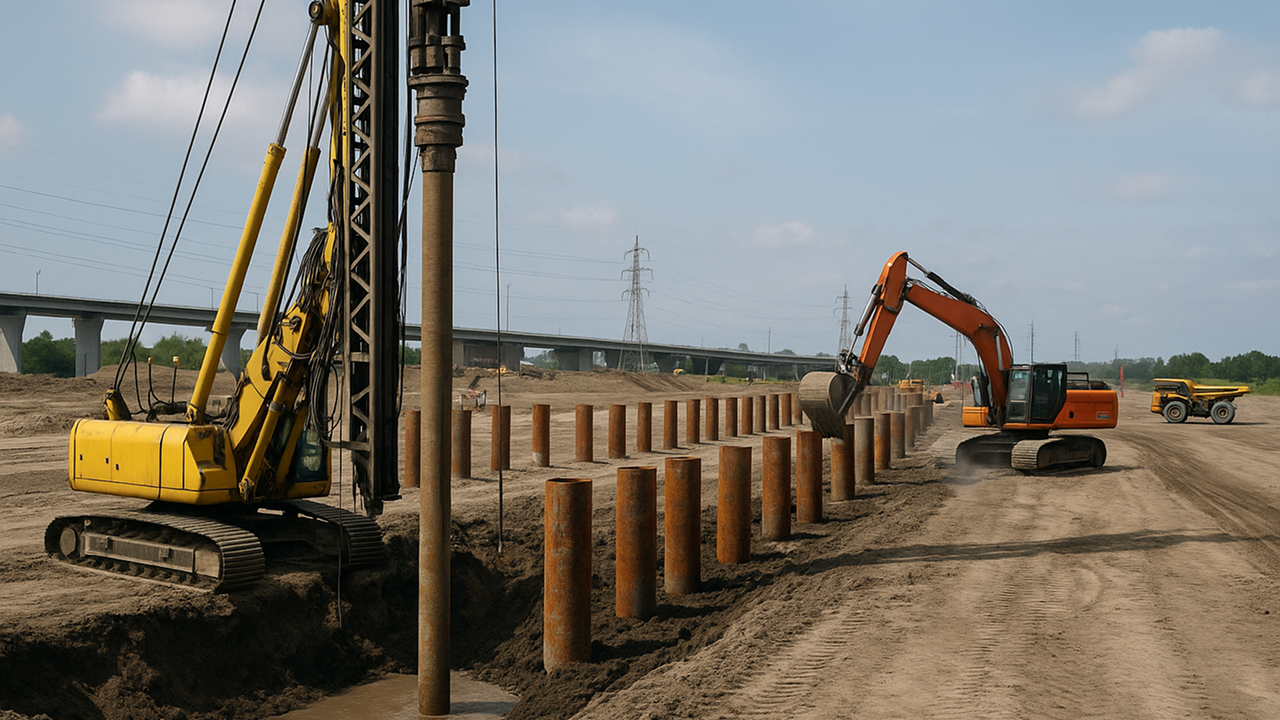
Critical infrastructure projects, including high-rise buildings, bridges, and industrial facilities, require robust foundation systems to ensure structural integrity and long-term stability. Deep foundation systems are essential for transferring substantial loads to deeper, more stable soil or rock layers, particularly in challenging geotechnical environments. Grimtech, a premier micropiles contractor in India, excels in delivering micropiles installation services, providing precise, adaptable, and minimally invasive solutions for complex projects across the nation.
Micropiles Construction and Installation
Micropiles construction and set up is a tested deep foundation answer used for strengthening present structures and helping new production in difficult ground situations. Micropiles are small-diameter, excessive-ability piles which can be drilled, bolstered, and stress-grouted to transfer structural hundreds to deeper, more potent soil or rock strata.
Our micropile construction services are designed for projects where conventional piling isn’t possible due to restricted get admission to, low headroom, weak soil, or present structural constraints. With superior drilling techniques and experienced execution, we deliver safe, long lasting, and price-effective micropile foundation answers.
Micropile Construction Services
We offer give up-to-stop micropile construction offerings for residential, business, business, and infrastructure tasks. From website research to very last load checking out, our team ensures precision, safety, and compliance with engineering standards.
Our services include:
- Micropile basis creation for new and current structures
- Micropile installation in constrained and low-clearance regions
- Underpinning and foundation strengthening the usage of micropiles
- Micropile load checking out and satisfactory warranty
- Design-assisted execution for complex soil situations
Micropiles are perfect for retrofitting antique buildings, bridges, basements, and foundations suffering from settlement or load boom.
Micropile Foundation Construction
Micropile basis production includes moving loads via a reinforced grout column into equipped soil or rock. These piles usually range from 100 mm to 300 mm in diameter however can deliver very excessive masses because of robust bonding with surrounding strata.
Micropile foundations are extensively used for:
- Foundation strengthening and rehabilitation
- Underpinning of current buildings
- Seismic retrofitting
- Slope stabilization and embankment assist
Their flexibility in layout and set up makes them a desired answer for urban and confined sites.
Micropile Installation
Micropile set up is finished the use of specialised drilling rigs which can perform in tight spaces and coffee headroom situations. The set up manner ensures minimum vibration, making micropiles appropriate for sensitive structures and close by buildings.
Key benefits of micropile installation:
- Suitable for weak, free, or variable soil conditions
- Minimal disturbance to present systems
- High load capacity with small diameter
- Can be established at any inclination
Micropiles Installation Method
The micropiles installation approach commonly includes the subsequent steps:
- Drilling – A borehole is drilled to the specified intensity the use of rotary or percussion drilling.
- Reinforcement Placement – A metallic bar or casing is inserted into the borehole.
- Grouting – High-energy cement grout is injected underneath pressure to bond the pile with surrounding soil or rock.
- Curing & Load Testing – The pile is allowed to advantage energy, followed by way of load trying out if required.
This method ensures awesome load switch and lengthy-term overall performance of the micropile basis.
Why Choose Micropiles Construction and Installation?
- Ideal for confined access and coffee headroom web sites
- Effective for basis strengthening and underpinning
- Minimal vibration and noise in the course of production
- Suitable for nearly all soil and rock situations
- Long carrier life with high structural reliability
Difference Between Bored Piles Construction and Micropiles Construction
1. Bored Piles Construction
Bored piles construction involves drilling large-diameter vertical holes into the ground and filling them with reinforced concrete. This method is commonly used for new construction projects where open access and heavy structural loads are involved.
Key characteristics:
-
Large diameter piles (typically 450 mm to 1500 mm)
-
Requires heavy drilling rigs and open working space
-
Suitable for high-rise buildings, bridges, and industrial structures
-
High load-bearing capacity
-
Not ideal for restricted or low-headroom sites
Best used when:
-
Site has sufficient working space
-
Structure carries heavy vertical loads
-
New foundation construction is planned
2. Micropiles Construction
Micropiles construction uses small-diameter piles drilled and pressure-grouted into the ground. This technique is ideal for restricted access areas, foundation strengthening, and underpinning of existing structures.
Key characteristics:
-
Small diameter piles (typically 100 mm to 300 mm)
-
Can be installed in low headroom and confined spaces
-
Minimal vibration and noise
-
Suitable for weak soil, rocky strata, and existing buildings
-
Relies on grout-to-ground bond for load transfer
Best used when:
-
Access is limited or headroom is low
-
Existing structures need strengthening
-
Minimal disturbance is required
3. Side-by-Side Comparison Table
| Aspect | Bored Piles Construction | Micropiles Construction |
|---|---|---|
| Pile Diameter | Large (450–1500 mm) | Small (100–300 mm) |
| Equipment | Heavy drilling rigs | Compact drilling rigs |
| Site Access | Requires open space | Works in restricted areas |
| Load Capacity | Very high (single pile) | Moderate to high (group action) |
| Vibration | Low | Very low |
| Application | New buildings, bridges | Underpinning, retrofitting |
| Cost | Economical for large projects | Cost-effective for repairs |
| Installation Speed | Faster in open sites | Slower but precise |
Frequently Asked Questions (FAQs)
What is micro piling in construction?
Micro piling in creation is a deep foundation method in which small-diameter piles are drilled, reinforced, and strain-grouted to transfer structural loads to deeper, stable soil or rock layers. It is commonly used for basis strengthening, underpinning, and creation in restrained spaces.
What is the development series of a micropile?
The construction sequence of a micropile consists of drilling the borehole, setting steel reinforcement, stress grouting with cementitious material, curing the pile, and appearing load trying out if required. This collection guarantees high load potential and strong bonding with surrounding strata.
What are the hazards of micro piles?
Some negative aspects of micro piles consist of better cost as compared to conventional piles for huge open sites, slower installation velocity in very hard rock, and the want for professional workmanship to make sure proper drilling and grouting first-class.
What is the structure of a micropile?
The structure of a micropile consists of a drilled borehole full of high-energy cement grout and strengthened with a steel bar or casing. The grout transfers load to the encircling soil or rock, while the metallic reinforcement presents tensile and compressive energy.